Does your sense of smell give you an insight into your brain health?
Surprisingly, yes!
My dad can't really taste his food anymore.
He has pretty much lost his sense of smell, maybe from the nerve damage from his vaccine injury, possibly from the medication he now has to take because of it. No one knows exactly what has caused it. When we ask him what he feels like eating, he jokes about it not mattering. I can't imagine it. I don't want to.
His mother went to the dermatologist at 92 years old and had a few spots burned off her face. He said, "I guess I won't see you again..." She went back at 94!
How I Want to Live at Every Age
My highest value is freedom!
Maybe it's because I was so sick with Crohn's when I was young. I was stuck in hospital for weeks at a time, and I felt guilty that I couldn't take my daughter to the park.
I watched my mother deteriorate and, eventually, die from the effects of alcoholism, yes. But as I get older, bolder and wiser, I realise that she must have experienced a deep lack of self-love and embodiment that she never could get past.
I watched that rip her apart slowly, over her whole life.
But it taught me how I didn't want to be. What a gift she gave me!
And then I watch my dad, 85, still mentally sharp, still just like himself, still funny, sometimes more grumpy than he used to be, but active every single day.
His mother lived until she was just shy of 96.
I want to live past 120.
Not just live. I want a lifespan that's a healthspan.
Our personality, our heart, our mind, that's who we are. I want to be all of me at every single age, not a faded version of myself hanging on.
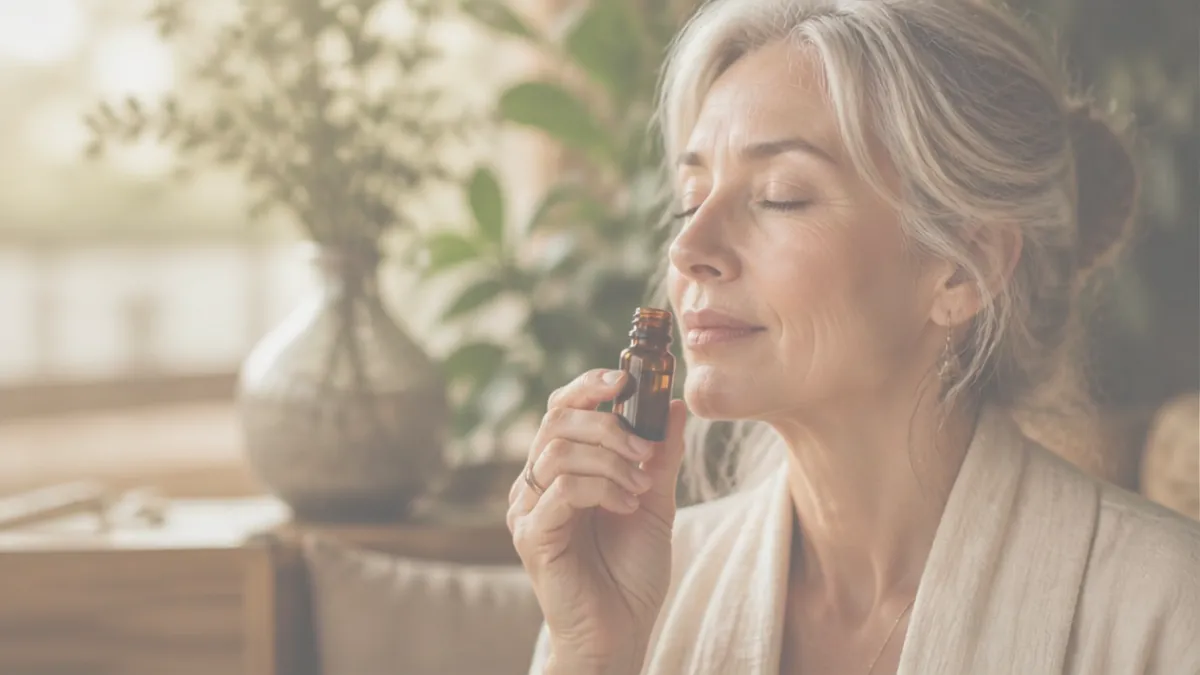
How does our sense of smell give us a sneak peek into how healthy our brain is? And why do I use essential oils the way I do, every day, for me and for my whole family?
The Day I Felt Empowered Instead of Powerless
Two years ago, I got a call from the farm manager. He told me he was taking my father to hospital.
My father had a stroke.
And I knew exactly which oils to reach for to support blood flow. Now I use oils to support his brain and neuropathy too.
As I drove down the freeway, I had a tonne of oils in my bag — I grabbed everything!
I knew there were oils to support flow, for emotions, for blood pressure... and they've been extensively studied.
Plus, I had my incredible naturopath who was sending me information about vitamin B12 in stroke recovery. I'm not sure why they didn't recommend this in the hospital. It's in peer-reviewed papers and everything!
Quite frankly, I am consistently disappointed at the current state of traditional medicine. Great in trauma or emergencies, sorely lacking in supporting wellness and longevity.
And even any kind of nutritional medicine - I mean, have you seen the crap they feed you in hospital?
Arriving at emergency to see my father, and having heard that he had a suspected stroke, made me feel powerless.
But in that moment, I wasn't just standing there. I had something I could do.
That's what oils have given me: tool after tool, when I need them.
Some might argue they did nothing. I disagree, but also, I don't care what others think.
They certainly weren't harmful and were definitely more beneficial than just having him sit in a chair for six hours before they did anything!!
I mean, days before they did an ultrasound and then they realised the clot was large enough that they should have operated on him for clot retrieval...
So What's Actually Going On?
There's a study that has piqued my interest. If you know me, you'll hear me say this often.
This study scanned the brains of professional perfumers (Delon-Martin et al, 2013).
People who work with scent all day, every day, for years.
And their brains were physically different.
Certain regions were measurably larger than in people who don't work with scent.
Your brain changes structural shape based on how much you use your sense of smell.
It makes sense when you think about it. The parts of your brain that process smell and the parts that process memory and cognition sit right next to each other, wired into the same circuitry.
When one lights up, so does the other.
The Warning Sign Hiding in Your Nose
In both mild cognitive impairment and Alzheimer's, one of the earliest changes isn't memory loss at all.
A reduced response to smell can be seen often before anything else is noticeable.
Which means your nose might be indicating something about your brain health well before you notice yourself forgetting things.
Researchers are now pushing for smell testing to become a normal part of general health screening, the same way we'd check blood pressure or cholesterol.
You can actually build a rough version of this test yourself at home with oils already in your collection.
If you don't have oils, reach out — I'd love to support you.
I'll walk you through exactly how to set it up properly on our next Deep Dive call, which we run each week and each month.
Zinc deficiency is also linked to loss of smell and taste, so you need to address your nutritional status too.
What the Research Says You Can Do
This is the bit I love.
There's real, published research on specific ways scent supports cognitive function.
Scent while you're on task.
Diffusing Rosemary while people did memory tests improved accuracy by 13% compared to a control group (Moss et al, 2003).
Peppermint showed similar benefits in later research.
Simple, and something you can start today.
Conditioning your memory.
Diffuse a scent while you're learning something, then use that same scent again when you need to recall it.
Students who did this performed significantly better than those given a different scent at recall time.
Scent while you sleep.
This one is wild.
Present the same odour during deep sleep that was present while you were learning something, and your brain consolidates that information into long-term memory more effectively (Rasch et al, 2007).
Olfactory enrichment.
A 2023 study had adults over 65 sleep with rotating essential oils diffusing at low levels every night for six months.
Memory improved by 226%.
I know, it sounds too good to be true.
It made me want to dig into it more too, which is exactly the kind of rabbit hole I love going down with you all on our calls.
There's also research on Peppermint, Rosemary and Cinnamon blends outperforming a Red Bull for alertness and reaction time during focus tasks (Schneider, 2020).
Make of that what you will next time you reach for caffeine instead.
My Own Ritual
I diffuse every night.
Every single day, oils are my first response, for me, for my children, for my family.
Brain Power is a blend that I keep coming back to for this kind of cognitive support.
There's a lot more to say about which oils, which timing, which combinations actually make the biggest difference here, and that's exactly what we go deep on together each month on our Deep Dive Oil Call.
We cover topics like this in real depth every single time, so if this is the kind of thing that lights you up, that's where to be.
Has anyone in your life lost their sense of smell, or noticed their memory changing?
What did you make of it?